
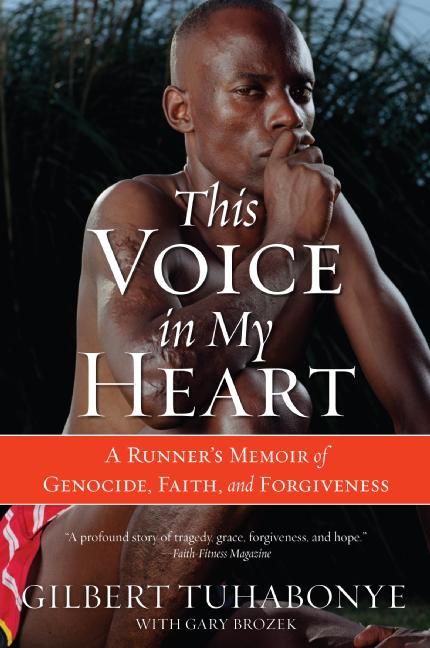
 The story of genocide is left to be told by the scarred souls who survive it. Scarred by fire, Gilbert Tuhabonye tells a story of evil so vast as to be incomprehensible – except perhaps in snippets.
In This Voice in My Heart: A Genocide Survivor’s Story of Escape, Faith and Forgiveness, Tuhabonye separates his story of the 1993 genocide in Burundi into snippets. Interspersed and italicized between the story of his life growing up in a small village in Burundi, these snippets allow us to absorb the story — without turning away in horror. But horrific it was, that day in October 1993, when Hutu neighbors butchered and burned Tuhabonye’s Tutsi classmates, teachers and friends. Tuhabonye alone survived the attack after breaking a window with a charred femur, avoiding a crowd of murderers and running through the woods with his skin aflame.
Tuhabonye survived, he believes, in order to tell the story. The “voice in his heart” spoke to him through the horrors, telling him that he would survive so that he could bear witness. That voice, Tuhabonye believes, was God, speaking strength, saving his life, and imbuing his days with new meaning.
Switching between the horrific and the mundane, This Voice in My Heart has a rhythm, a pace, a melody, that draws you in. A morbid fascination with the acts of ordinary citizens gone feral is balanced against daily life in a place with limited electricity, water drawn from a well, and no indoor plumbing. You learn how running – the discipline, the ability to endure pain, and ultimately the opportunities for travel – played a powerful role in Tuhabonye’s life (including bringing him to Austin, Texas where he now lives and coaches other runners). You also learn how the massacre strengthened Tuhabonye’s faith, and how that faith has become the central tenet of his life. About how, after surviving the holocaust, Tuhabonye runs through life to tell his tale.
I have the great privilege of knowing Gilbert, and had the even greater privilege of getting to witness the telling of his tale and write about it. It is a story that still haunts me.
This Voice in My Heart contains a photograph of a monument on the site of the massacre. It reads “Never Happen Again.” In the face of the mass killings in Darfur, in Syria, in Yemen, it is hard not to be cynical about such sentiments. Yet after reading Tuhabonye’s story, told without rancor, one is led to have faith that in hope there is the possibility of redemption.
UPDATE: Gilbert still runs. He still coaches other runners. And his mantra is: Run with Joy. On the one hand, knowing his history, I wonder – how can he run with joy? And, yet, on the other, hand, how can he not run with joy? Gilbert has also started a charity, the Gazelle Foundation, that helps to provide clean water to the villages in Burundi near where he grew up. He has combined his love of running to fund the wells and clean water by organizing the Run for the Water event every fall in Austin, and also raises funding for the water projects through a Spring for the Water Gala. If you can’t attend either event, you can still support the important work that the Gazelle Foundation is doing. Sometimes we think one person can’t make much of a difference in our world. Gilbert’s life choices show just how wrong such thinking is.
 BooksByPeopleIKnow